

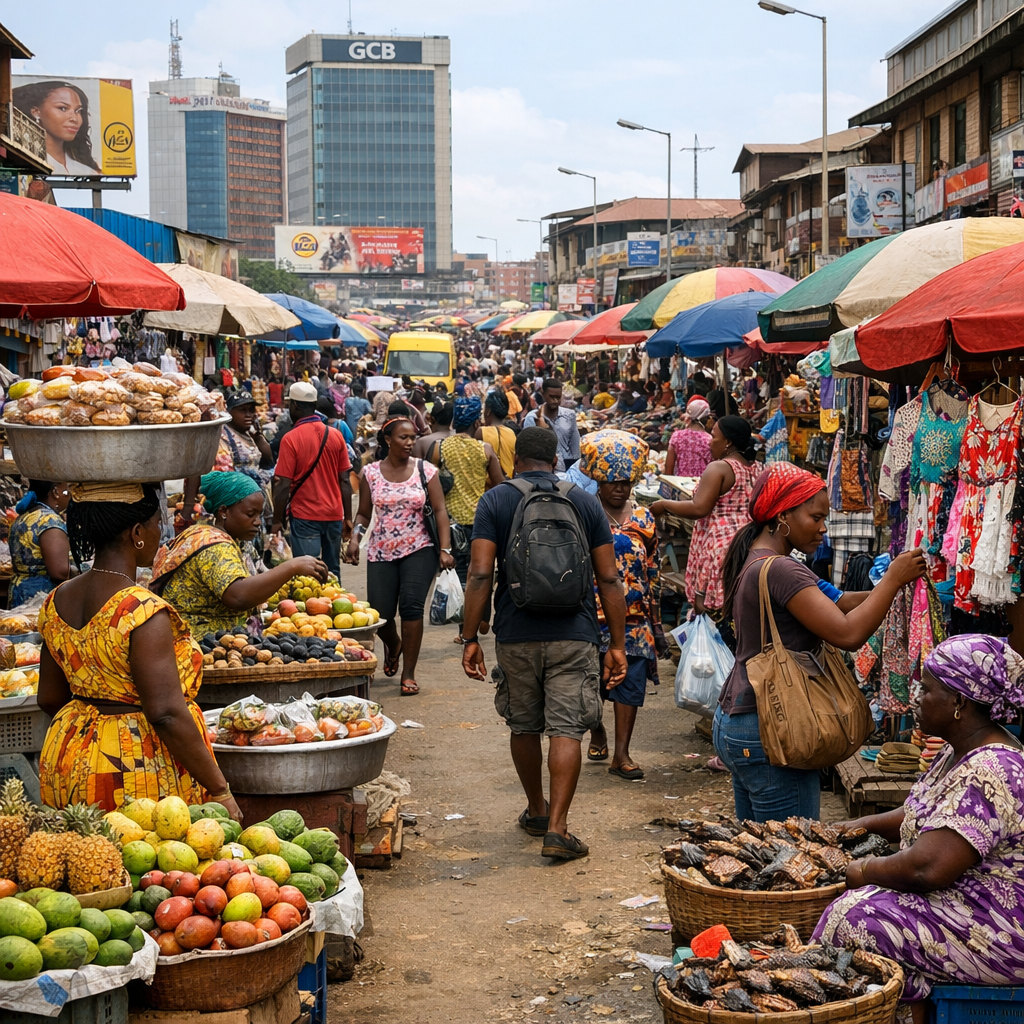
Accra’s economy is often measured by formal structures—registered companies, banking systems, tax records, and official employment statistics. However, beneath these visible layers lies a sprawling ecosystem that fuels daily commerce, supports millions of livelihoods, and keeps the city functioning: the informal sector. From street vendors and artisans to ride-hailing drivers, market traders, and small-scale service providers, the informal economy is not just a side character in Accra’s development story—it is the backbone.
Despite lacking the recognition and support given to formal businesses, the informal sector remains one of the most resilient, innovative, and adaptable economic engines in Accra. According to the latest Integrated Business Establishment Survey (IBES) released by the Ghana Statistical Service (GSS), Ghana is home to a total of 2,644,358 businesses. The data indicates that 1.87 million businesses (70.6%) operate from fixed structures, whereas 693,748 businesses (26%) operate in open spaces and 82,920 (3.1%) are mobile. Open-space and mobile businesses collectively account for nearly 30% of all enterprises, highlighting their crucial role in facilitating daily commerce and access to goods and services nationwide.
Furthermore, the data reveals that open-space businesses alone provide employment to over 922,000 individuals, rendering them a significant source of job creation. These businesses are predominantly concentrated in the Greater Accra and Ashanti regions, reflecting robust urban demand and commercial activity. Nationally, approximately 63.7% of open-space businesses operate for at least six days a week, with the highest frequency observed in Greater Accra (77.5%) and Ashanti (73.1%). In the Northern Region, nearly half (48%) of these businesses operate seven days a week. The survey also sheds light on gender dynamics within the sector, revealing that almost 80% of individuals engaged in open-space but fixed-location businesses are women, while an overwhelming 99.2% of open-space businesses are owned by Ghanaians.
Additionally, mobile businesses, numbering 82,920 nationwide, underscore the substantial contribution of non-traditional enterprises to livelihoods and local commerce. Overall, the findings underscore the centrality of informal and semi-formal businesses to Ghana’s economic activity, characterized by varying scales, employment levels, and income-generation potential across the country.
Despite their significant contributions, informal sector workers often face challenges such as limited access to credit, lack of social protection, and vulnerability to economic shocks. Recognizing and supporting this sector is crucial for fostering inclusive economic growth and development in Accra.