

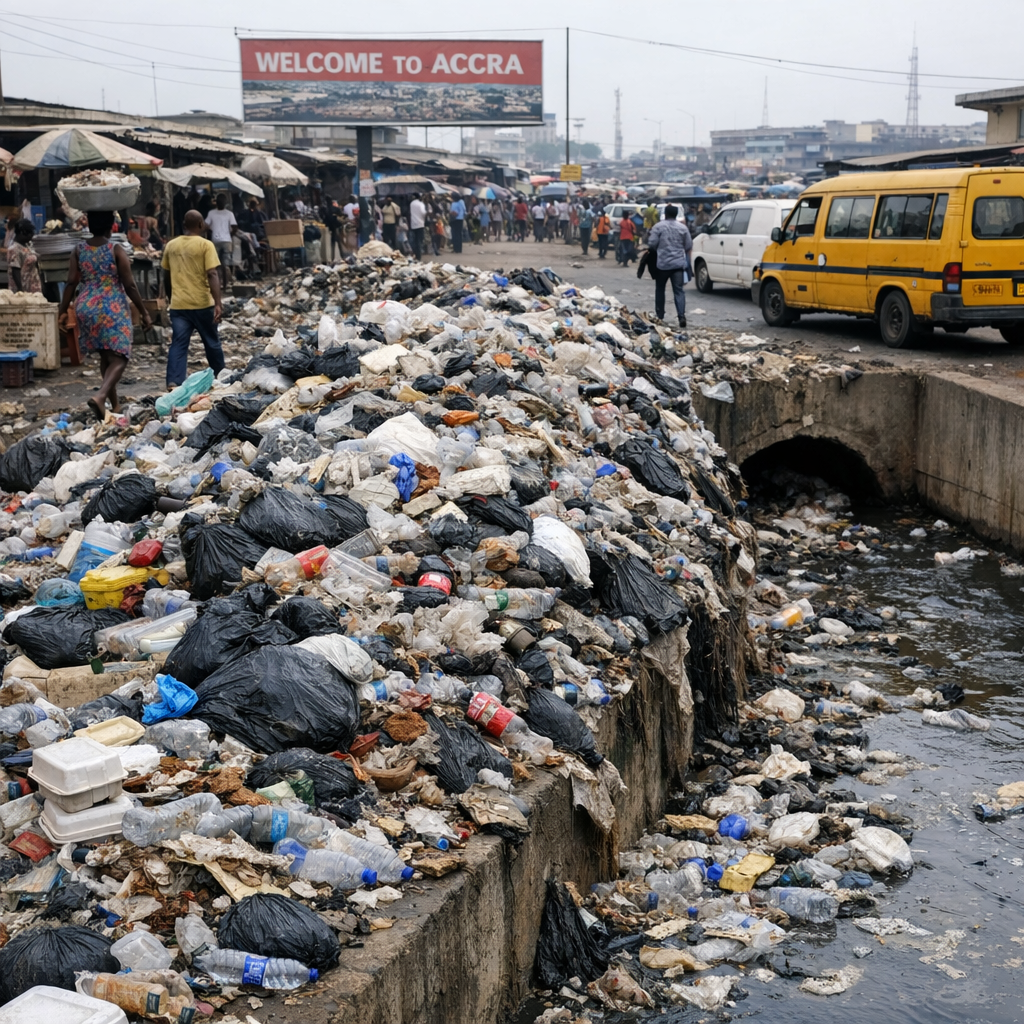
Accra, Ghana’s bustling capital, continues to grapple with significant sanitation challenges that impact both public health and the environment. Despite various initiatives, issues such as waste accumulation, inadequate sanitation facilities, and insufficient waste management infrastructure persist across the city.
Persistent Waste Accumulation
In areas like the Kwame Nkrumah Interchange, residents and workers have expressed frustration over recurring sanitation problems. Despite regular cleanup efforts, waste continues to pile up due to a lack of waste bins and other systemic challenges. Authorities are being urged to address the problem. Anthony Oduro, a driver in the area, lamented the lack of proper waste disposal facilities. He stated, “After the elections, rubbish is everywhere. At this station, we pay our workers to keep the place neat; it is not Zoomlion that cleans here. We don’t have a proper place to keep our rubbish, and we plead with the government to provide one.” Similarly, Emmanuel Modzaka, a supervisor at the new station in Odawna, emphasized their efforts to maintain cleanliness. He said, “The sanitation here is good because we clean constantly.”
Inadequate Sanitation Facilities
Access to proper sanitation facilities remains a pressing concern. A World Bank-sponsored survey revealed that residents consider toilet and sanitation to be their highest priority. The report indicates that many residents perceive workers of the assembly to be corrupt and incompetent. The survey touched on issues such as the states of toilets, drains and gutters, refuse and solid waste collection in the capital. Residents consider toilet and sanitation to be their highest priority and roads their least. The report says only one-fifth of residents in Ablekuma, a suburb of Accra for example, are satisfied with the state of gutters in the area. The report also established many residents are concerned about filth at public markets. Close to two-thirds of public market users in all sub-metros report that the markets are dirty. Residents are also dissatisfied with the poor manner the city authority fixes service problems. Residents are therefore unwilling to report their problems to the assembly.
Informal Settlements and Waste Management
Informal settlements like Old Fadama, Nima, and Agbogbloshie face severe sanitation challenges. These densely populated areas often lack basic infrastructure, leading to improper waste disposal and environmental degradation. In Agbogbloshie, for instance, electronic waste recycling activities have resulted in significant pollution, posing health risks to residents. The area is infamous for its electronic waste recycling activities. Known as one of the most polluted places in the world, the area is a hub for informal economic activities but poses severe health risks due to toxic fumes from burning electronics and improper waste disposal. Residents here face daily challenges from both pollution and limited services.
Efforts Towards Improvement
The Accra Metropolitan Assembly (AMA) has initiated several measures to address these issues. Mayor Michael Kpakpo Allotey has overseen projects such as restoring 150 broken streetlights along major avenues and fixing damaged roads around Rawlings Park. Additionally, the AMA has intensified the removal of unauthorized billboards and signages to restore order and protect the city’s visual appeal. The Mayor affirmed, “We are determined to ensure a cleaner and healthier environment for our residents.”
Community Involvement
Community engagement plays a crucial role in improving sanitation. In Accra, modern waste compaction trucks typically serve areas whose residents (and businesses) can afford monthly waste collection fees of over 150 GHC (~US$30). Trucks, mainly operated by companies in the formal sector, offer door-to-door waste-collection on networks of accessible roads. In contrast, given the limited affordability and often narrow alleyways in low-income communities (including some parts of the community studied), tricycles (known locally as Borla Taxis or Aboboyaas) or porters in the informal sector are widely used. Residents may also deposit their waste at public dumps. In common with other parts of Accra, this community’s waste collection is overseen by local government, with day-to-day operations outsourced to a private company (the formal sector).
Conclusion
While efforts are underway to tackle Accra’s sanitation challenges, a comprehensive and sustainable approach is essential. This includes improving waste management infrastructure, increasing access to sanitation facilities, and fostering community participation. Addressing these issues is vital for enhancing the quality of life for Accra’s residents and ensuring the city’s sustainable development.